Think of eye contact as shared attention
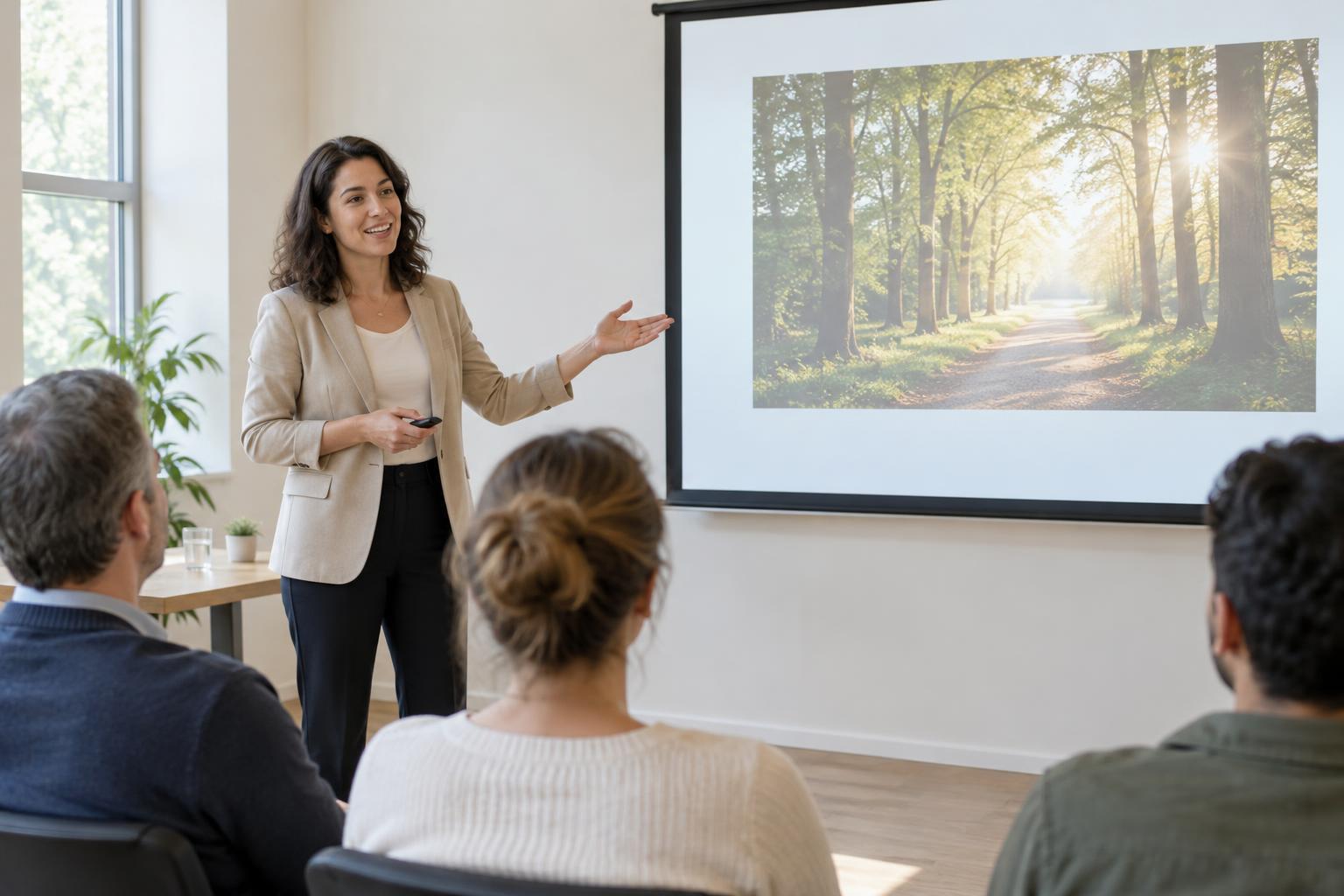
When you are new to public speaking, the instruction to “make eye contact” can sound like one more task to perform correctly. It may help to replace that instruction with a simpler aim: let different parts of the group feel included. You do not need to meet every person’s eyes, and you certainly do not need to stare. A brief, comfortable glance toward someone as you finish a thought is often enough.
Looking at your audience also gives you a way to notice how your message is landing. Are people following along, or might a point need a clearer example? You cannot read anyone’s mind from a facial expression, so avoid treating one frown or averted gaze as a verdict on your talk. Your goal is to stay connected to the room, not to monitor every reaction.
Give your gaze a gentle route around the room
Before you begin, notice the broad areas where people are sitting: perhaps left, center and right, with a back row if the room is deep. As you speak, direct one complete thought toward one area, then move to another. This is more natural than shifting your eyes with every word or following a fixed pattern that makes you feel mechanical.
Within each area, you can look toward a person who seems comfortable listening. Stay for a sentence or the end of a phrase, then move on. If direct eye contact feels too intense, looking at someone’s face without trying to lock eyes may feel easier. In a large room, looking toward a small cluster of seats can serve the same purpose. People farther away are unlikely to know precisely where your gaze rests.
Remember the edges of the room. Speakers often focus on a friendly face in the middle and unintentionally leave everyone else out. An occasional glance toward quieter corners can make your delivery feel more inclusive. There is no required number of seconds to spend in each place; let the rhythm of your ideas guide you.
Use notes without disappearing into them
Notes are useful, especially when you are learning. The challenge is not to avoid looking down but to make it easy to look back up. Try writing brief prompts rather than full paragraphs, with enough space between points to find your place quickly. You can glance down for the next idea, lift your gaze, and explain it in your own words.
Plan a few natural moments to reconnect with the room: the opening sentence, the main point of each section, an example, and the closing thought. If you need to read an exact phrase, read it. Then pause and look up before continuing. That small transition can feel more composed than trying to read and scan the audience at the same time.
If you are using slides, avoid turning toward the screen for long stretches. Check a slide when needed, then face the group to explain why it matters. The same principle applies to a video call: you can look at faces on the screen while listening and glance toward the camera when making a key point. Constantly watching the camera is not necessary.
Make the approach fit you and your audience
Direct eye contact is not equally comfortable or appropriate for everyone. Personal preferences, cultural norms, vision differences and the demands of a particular setting can all affect how people look and listen. A listener who looks away may still be paying close attention. Likewise, you can communicate warmth and clarity without forcing yourself into a gaze pattern that makes it harder to speak.
If eye contact feels difficult, start with an easier version. Look toward the back of the room while you say your opening lines, then choose a few approachable faces or areas as you settle in. You might rehearse with two or three people and practice moving your attention between them at the end of each idea. The aim is not to look effortless; it is to find a way of connecting that lets you keep communicating.
After a talk, reflect on what helped rather than scoring yourself on how often you looked up. Did your notes leave room to speak freely? Did you include more than one part of the audience? Did you recover when you lost your place? Those observations give you something useful to try next time. With practice, where to look becomes less of a separate task and more a natural part of sharing an idea.