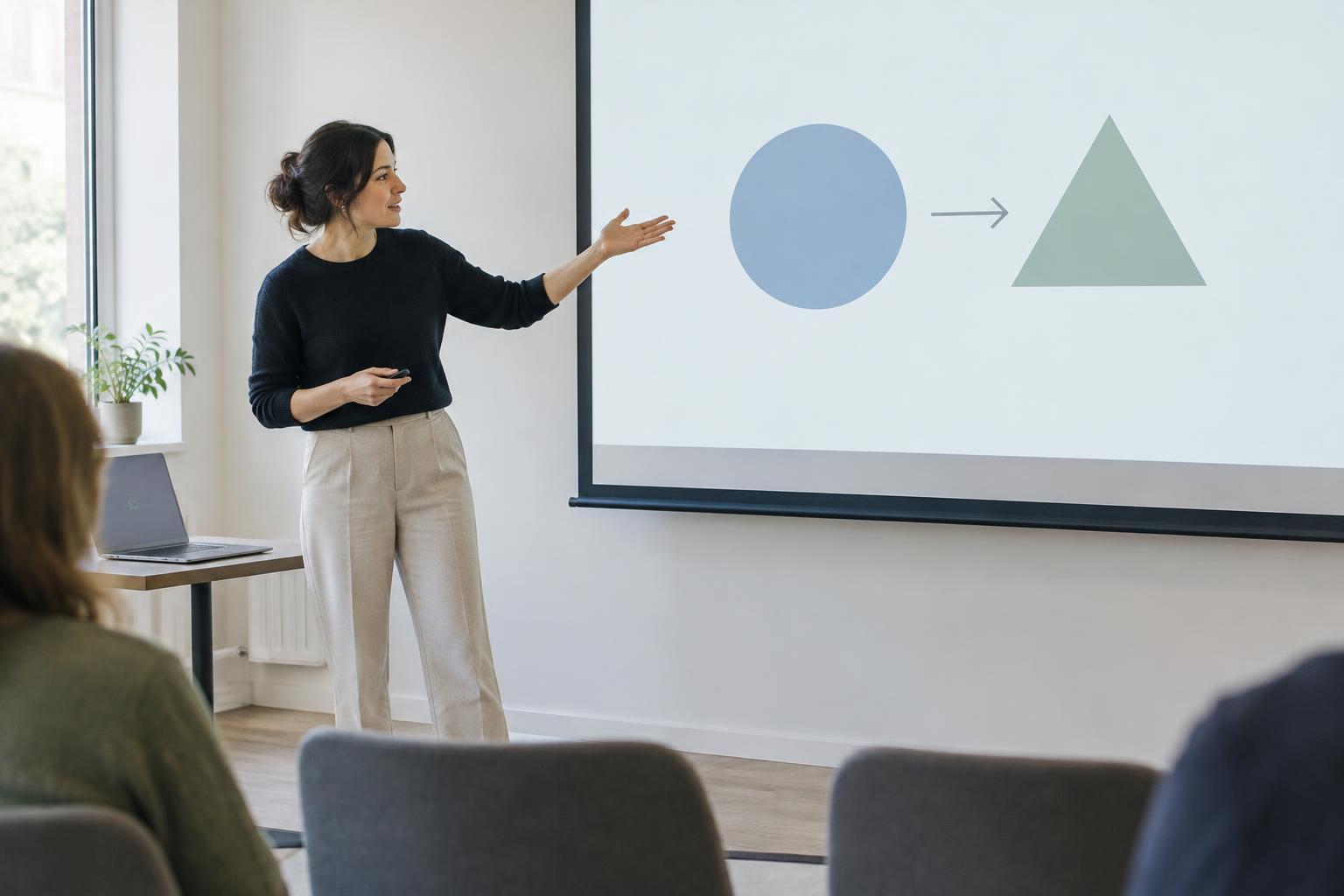
Give movement a job
When you speak, your audience is trying to follow both your words and your presence. A gesture can help illustrate a contrast, mark a sequence or emphasize a key point. Movement becomes distracting when it has no clear relationship to what you are saying. You do not need to stand still, but it helps to ask what each noticeable movement is doing for the listener.
Before rehearsing gestures, identify two or three moments in your talk that deserve extra clarity. Perhaps you compare two options, explain a process or arrive at your main takeaway. Those are useful places for a simple hand movement or a change in position. Let the rest of the talk feel conversational rather than trying to assign a gesture to every sentence.
Start from a comfortable resting position
Many distracting habits begin with a practical question: What should I do with my hands between gestures? Choose a resting position you can return to without thinking much about it. You might let your arms rest loosely by your sides or hold your hands lightly in front of you. If you use notes or a clicker, hold them in a way that does not require constant adjusting.
Aim for ease rather than a fixed pose. Gripping your hands tightly can make every movement feel abrupt, while forcing them to remain still may take attention away from your talk. When you finish a gesture, allow your hands to settle. This gives the gesture a clear ending and gives your audience a moment to absorb the point.
Match gestures to the idea, not to every word
Simple gestures often work best. You can show size or distance with your hands, use one hand for the first option and the other for the second, or count a short list on your fingers. Keep the movement broad enough to be seen from the audience's distance, but avoid exaggerating it solely because you are speaking publicly.
Timing matters more than variety. Begin a gesture as you introduce an idea and let it finish when that idea is complete. Repeating the same motion throughout a paragraph can compete with your words, especially if you are not aware you are doing it. In practice, notice whether a gesture helps explain something or merely fills a pause. A pause is allowed to remain a pause.
Move your feet with a purpose
A change of position can signal a new part of a talk or help you connect with another area of the room. Try moving during a transition, then stop and speak from a settled position. This is generally easier to follow than pacing continuously while delivering a detailed explanation. You can also stay in one place for the entire talk if the space, format or your comfort makes that the better choice.
Take a look at the space before you begin. Check where you can walk without blocking a screen, drifting away from a microphone or turning your back on listeners. If you are speaking while seated or on camera, the same principle applies on a smaller scale: let changes in posture or hand position serve the idea rather than become an ongoing activity.
Practice for awareness, not perfection
Rehearse a short section aloud and, if possible, record it. Watch once with the sound off to notice repeated motions, then listen normally to see whether those motions support what you are saying. Pay particular attention to transitions and pauses. You may discover that you already gesture naturally and only need to reduce one habit, such as shifting your weight or handling your notes.
Change one thing at a time. For example, practice returning your hands to rest after a key point, or plant your feet while explaining a complex idea. Too many physical instructions can make a talk feel stiff. The goal is not to look like a particular kind of speaker; it is to make your message easier to receive while speaking in a way that remains comfortable for you.