Start with the purpose, not the page count
A journal can hold useful observations, unfinished thoughts, ordinary details, and feelings you needed to put somewhere for a while. Those entries do not all need to become a permanent record. Before sorting anything, ask what you want your journal to do for you now. Do you want a record of meaningful changes, a source of ideas, a reminder of what helped during difficult periods, or simply more room on a shelf?
Your answer can be modest. You do not need a complete account of your life for your writing to have value. You might keep entries that help you understand a decision, archive entries you are not ready to revisit, and discard repetitive pages that served their purpose when you wrote them. Deciding what to retain is part of using a journal, not a judgment on whether your past thoughts were worthwhile.
Give each entry a quick, fair review
Choose a manageable batch, such as one notebook or a small folder of files. Skim rather than reread every sentence closely. As you go, ask: Would I be glad to find this again? Does it contain a detail, idea, or lesson I cannot easily recover elsewhere? Would keeping it feel useful, neutral, or burdensome? A few words beside an entry, such as “keep,” “maybe,” or “done,” are enough for a first pass.
Look for value beyond polished writing. A short note about a conversation may remind you how you learned to speak up. A list of questions may show what mattered to you at the time. On the other hand, a long entry may contain nothing you need to carry forward. Length, neatness, and emotional intensity are not reliable measures of whether an entry belongs in your collection.
If reviewing a particular page feels overwhelming, set it aside. You can decide later, without forcing yourself to reread it today. A sorting session is more useful when it has a stopping point; it does not have to settle every question at once.
Keep what you expect to use or appreciate
Keep entries that offer a clear reason to return. They might capture a turning point, preserve a memory in your own words, record a helpful routine, or show how your thinking changed. You may also want to keep writing that simply makes you smile. An entry does not need to be profound to deserve space.
Make the kept material easy to find. For paper journals, a small note on the inside cover can point to pages you value. For digital writing, a consistent filename or a small index may be enough. You can copy a useful sentence into a separate notes file rather than keeping an entire entry. This is especially helpful when one insight is worth saving but the surrounding details are not.
Archive the entries that need distance
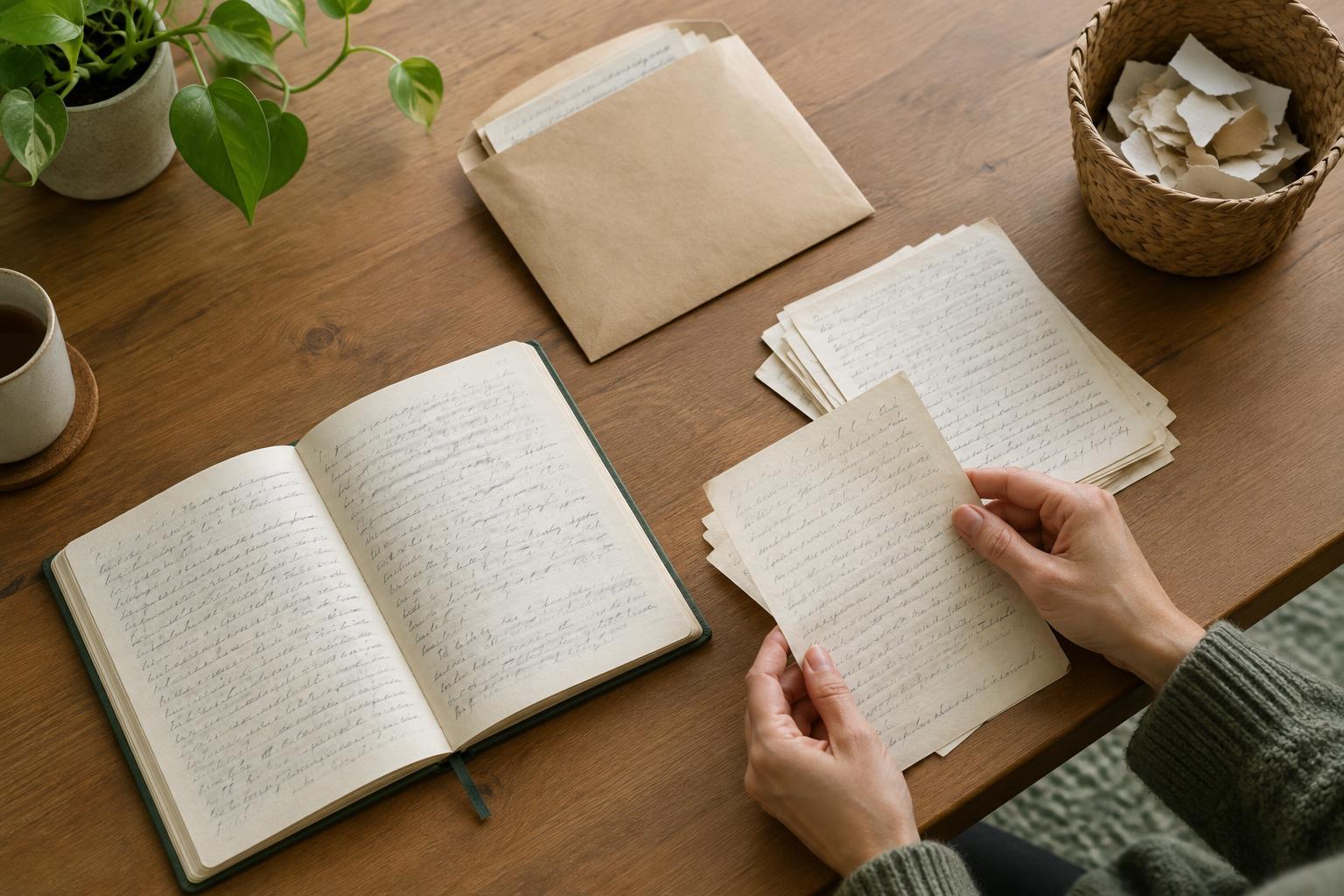
Archiving is a practical middle choice when you do not want an entry close at hand but are not ready to let it go. Put paper pages in a labeled envelope or box; move digital entries into a clearly named folder. A broad label such as “older journals” may be more comfortable than a detailed description. The point is to reduce clutter in your everyday space without making an irreversible decision.
Consider setting a simple review cue, such as looking at the archive when you reorganize your notebooks. You do not need to promise yourself a fixed date. If you never return to a particular entry, that may tell you something when you next decide whether to keep it. Before archiving digital writing, check that the files can still be opened and that any backup you rely on is stored somewhere you can access.
Discard deliberately and protect your privacy
Discarding an entry can be a quiet housekeeping decision. You may no longer need a page of repeated complaints, rough drafts you have already used, or notes that feel too private to retain. If you are unsure, save a brief summary of what you learned and let the longer entry go. You can change the format of a memory without preserving every original word.
Think about where discarded writing will end up, particularly if it includes names, addresses, workplace details, or sensitive information about other people. Shredding paper or securely deleting digital files may be more appropriate than putting them in an ordinary bin or leaving them in a shared folder. If a digital entry exists in backups or synced devices, deleting one copy may not remove the others.
Finish by returning to the reason you journal in the first place. Keeping everything can make it hard to find what matters; discarding everything can remove reminders you would welcome later. A thoughtful mix of keeping, archiving, and letting go leaves your journal as a tool you can use, rather than a collection you feel obliged to maintain.