Let go of the need for a story
When a day feels uneventful, you might try to recall its most important moment and find that nothing qualifies. That does not mean you have nothing to write about. Reflective writing does not need a turning point, a lesson or an impressive opening. It can begin with something as small as making a cup of tea, pausing before you answered a message or noticing that a familiar walk felt different.
A useful moment is one you can look at closely, not necessarily one you would tell someone else about. Give yourself permission to choose a scene that seems ordinary. The details you remember, and the questions they raise for you, can become the substance of the entry.
Scan for moments with a little texture
Rather than replaying the whole day from morning to night, look for a few simple anchors. Where did you stop for a minute? What task took longer than expected? When did your attention shift? Did you put something off, finish something small, enjoy a brief exchange or change your mind about a plan? These questions can bring a moment into view without asking you to judge whether it was significant.
Concrete details help. You may remember the sound of dishes being put away, a sentence you rewrote twice or the relief of sitting down after an errand. If several moments come to mind, jot down a few words for each. You are collecting possibilities, not committing to an entry yet.
Choose the moment that invites a question
Once you have two or three possibilities, pick the one that makes you even slightly curious. You might wonder why an easy task felt difficult today, why a short conversation stayed with you or what made a routine part of the day pleasant. Curiosity gives you somewhere to go on the page; you do not need to know the answer before you start.
If nothing stands out, use a simple rule to make the choice. Write about the last thing you can recall clearly, the first moment when you took a break or an object you handled more than once. A rule removes the pressure to find the perfect subject. You can always write about a different moment another day.
Stay with the scene before interpreting it
Begin by describing what happened in a few sentences. Where were you? What were you doing? What did you notice? For example: “I stood by the kitchen counter after dinner and looked at the dishes. I washed one mug before deciding to leave the rest until morning.” A modest description gives you something specific to reflect on.
Then follow with one gentle question: “What was I hoping for in that pause?” or “What made that small decision feel useful?” You do not have to turn the answer into a broad statement about yourself. Perhaps you were tired, wanted a clear counter or simply preferred to stop. An honest, limited observation is enough. If the question leads nowhere, return to the scene and add another detail.
Give yourself a stopping point
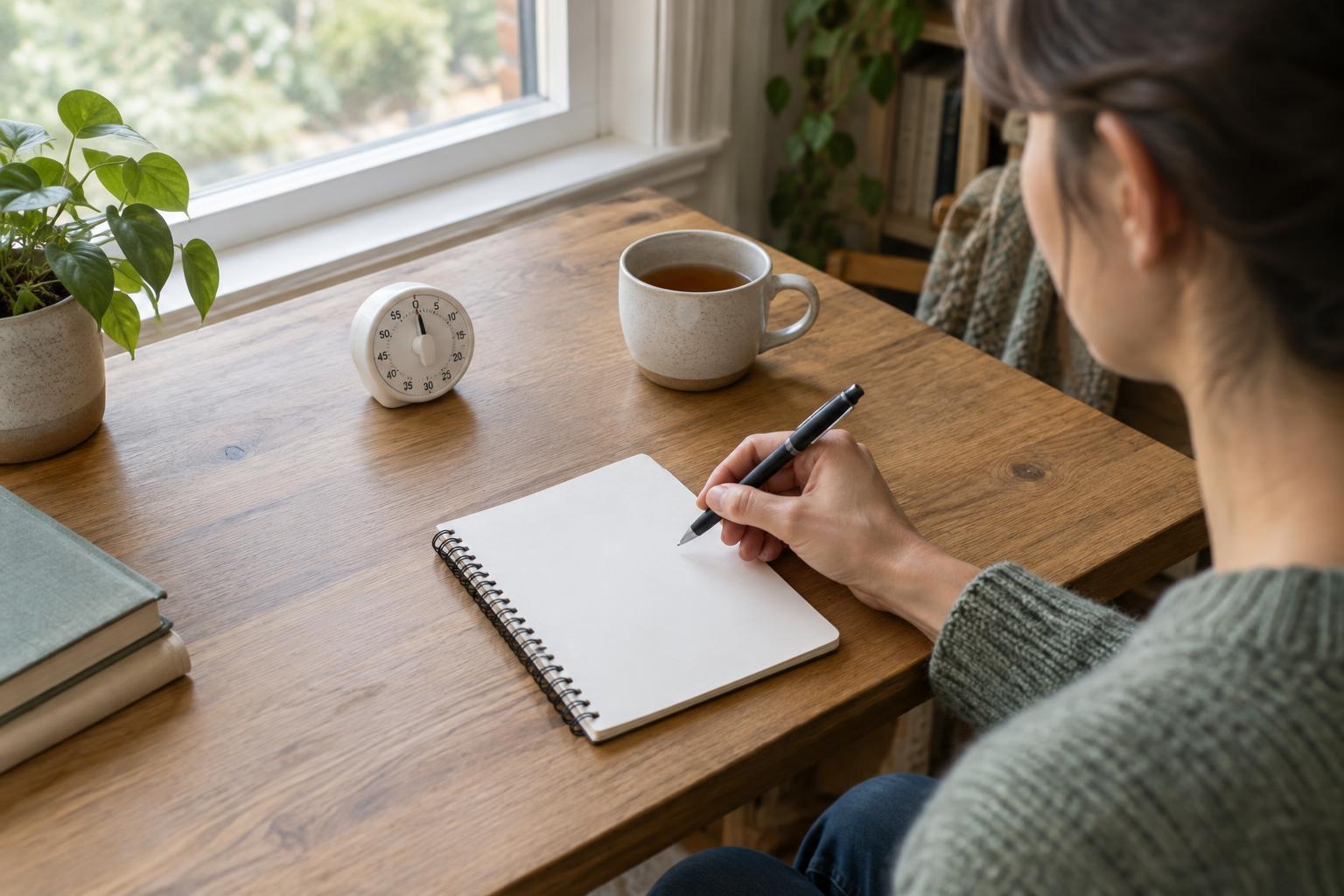
On an ordinary day, a short entry can be the whole entry. You might write five sentences: one to place the moment, two to describe it, one to name what you noticed and one to say what you are still wondering. This shape is a starting point, not a test. You can stop after the description if that is all you want to write.
Over time, small entries may help you notice what repeatedly catches your attention: a pleasant transition between tasks, a conversation you keep thinking about or the conditions that make a routine easier. There is no need to search for a pattern in every entry. The immediate aim is simpler: choose one moment, spend a little time with it and let an uneventful day be worth recording as it was.